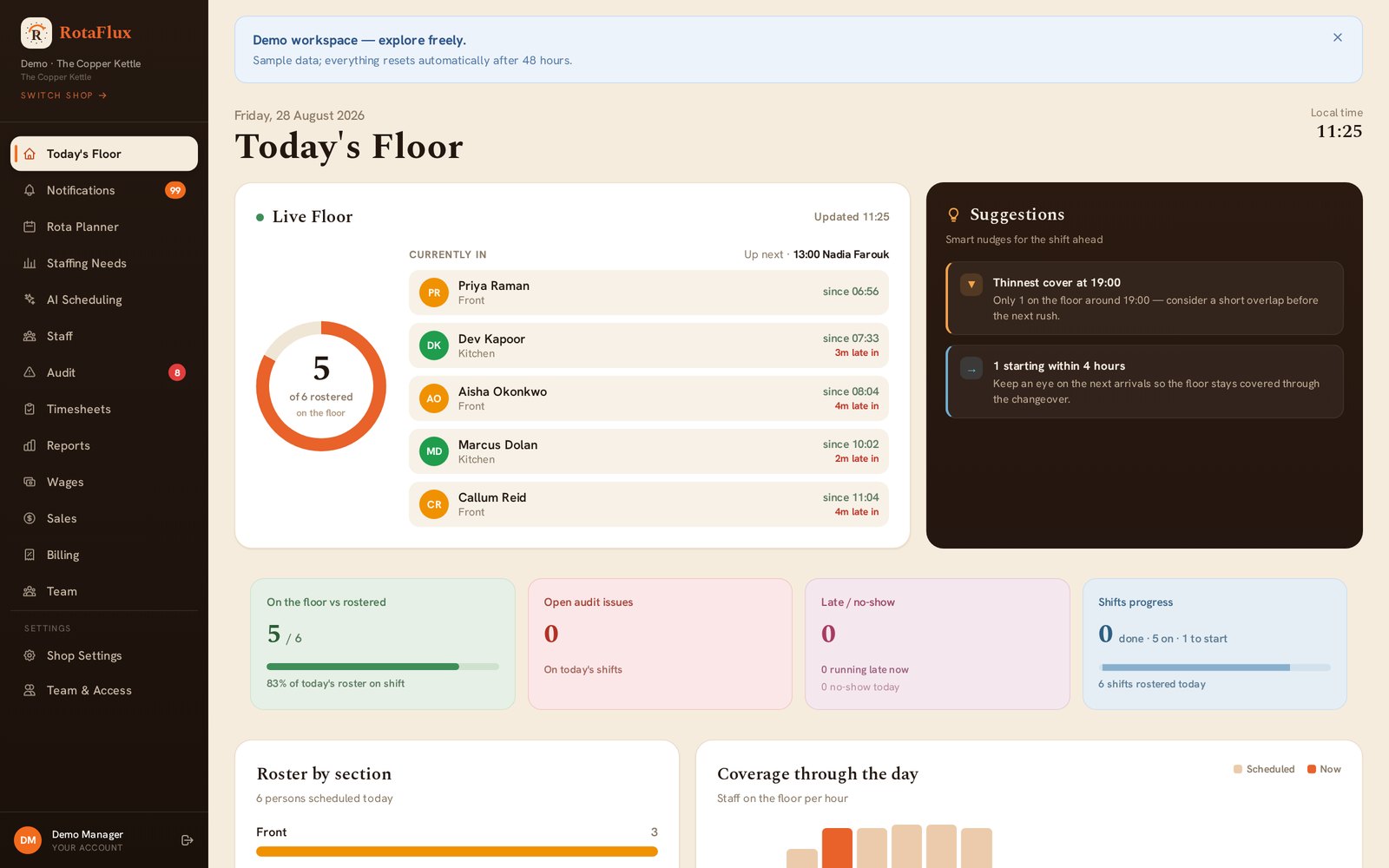
RotaFlux replaces the spreadsheet-and-WhatsApp rota with a single operational system for shift-based businesses. A manager opens one screen and sees who is on the floor right now, who is late, which shifts are unfilled, what the week costs, and what the tills took - then lets the scheduling copilot draft next week against real demand.
RotaFlux is an AI-powered workforce management platform built for cafés, restaurants, bars and small retail chains in the United Kingdom. We designed and engineered the product end to end: the multi-tenant data model, the scheduling engine, the live floor telemetry, the audit and compliance trail, the payroll-grade timesheet pipeline, the sales analytics layer and the entire interface system. The result is a product that a duty manager can run a shift from on a phone behind the bar, and that an owner can run a P&L conversation from on a laptop at home.
The Challenge
Shift businesses lose money in three invisible places: over-covered quiet hours, under-covered rush hours, and unverifiable clock-in data that quietly inflates payroll. Existing tools solved one of those and ignored the other two, and none of them connected labour cost back to what the tills actually took.
The Outcome
A single operational surface where demand, rota, attendance, cost and revenue are the same dataset. Managers plan a week in minutes instead of an evening, exceptions surface themselves instead of being discovered at payroll, and labour spend is finally readable against takings on the same timeline.
Explore it live
Key Highlights
- ✦AI scheduling copilot: demand → open shifts → assignments in one run
- ✦Live floor telemetry with late, no-show and coverage-dip detection
- ✦Clock-in audit queue with a defensible exception trail
- ✦Payroll-grade timesheets with approval workflow
- ✦Sales ingestion with labour-cost-against-takings reporting
- ✦Multi-shop tenancy with granular team roles and access
Tech Stack
Inside the product
Captured from the live product. Select any frame to enlarge.
Today's Floor
The shift-day command screen. Live clock-in state, on-the-floor versus rostered, late and no-show counts, roster by section, hour-by-hour coverage, and a suggestions panel that nudges the manager before a dip becomes a queue at the till.
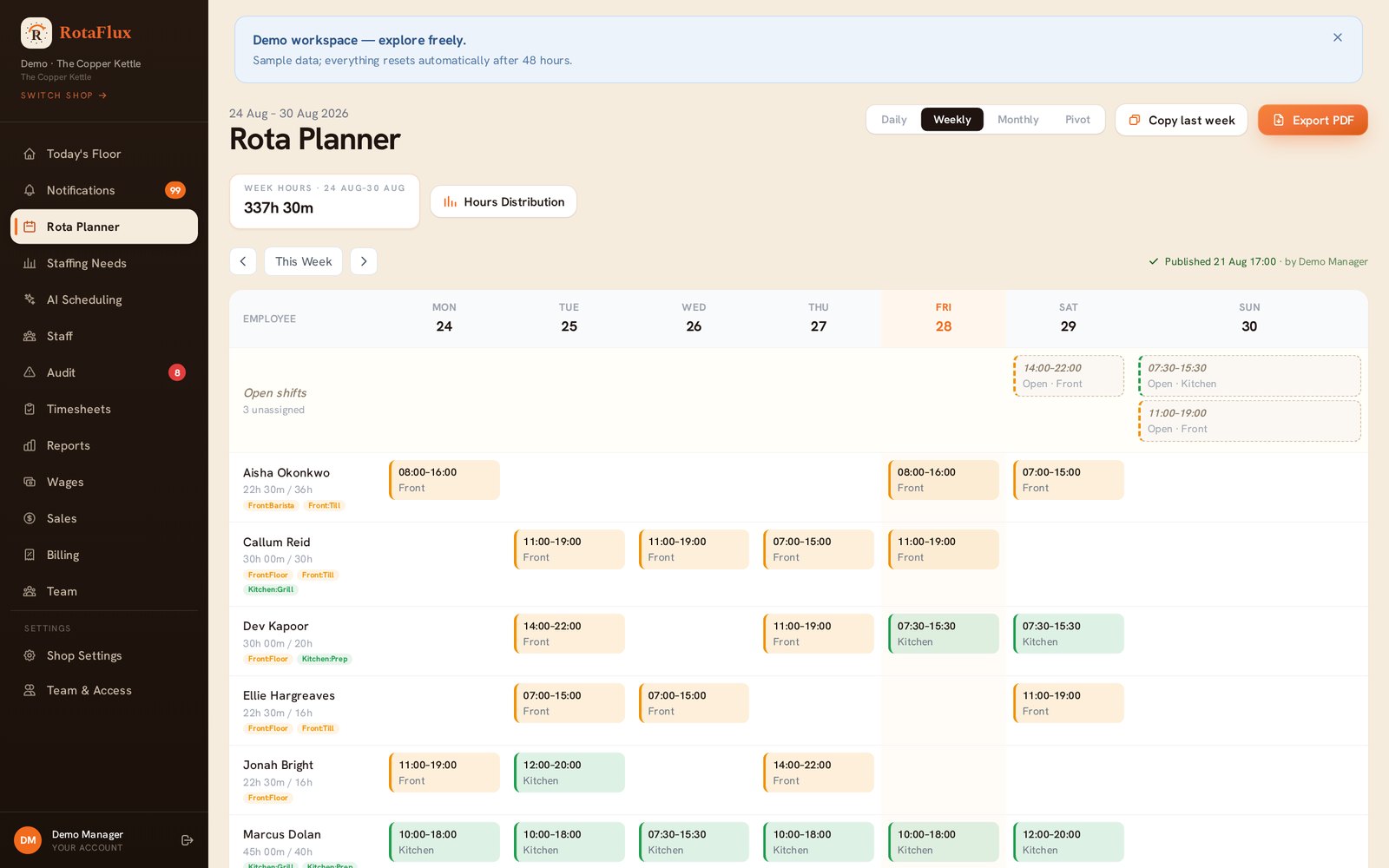
Rota Planner
Daily, weekly, monthly and pivot views over the same week. Open unassigned shifts sit in their own lane at the top, each employee row carries scheduled-against-contracted hours and skill tags, and the week can be published, copied forward or exported to PDF for the staff room wall.
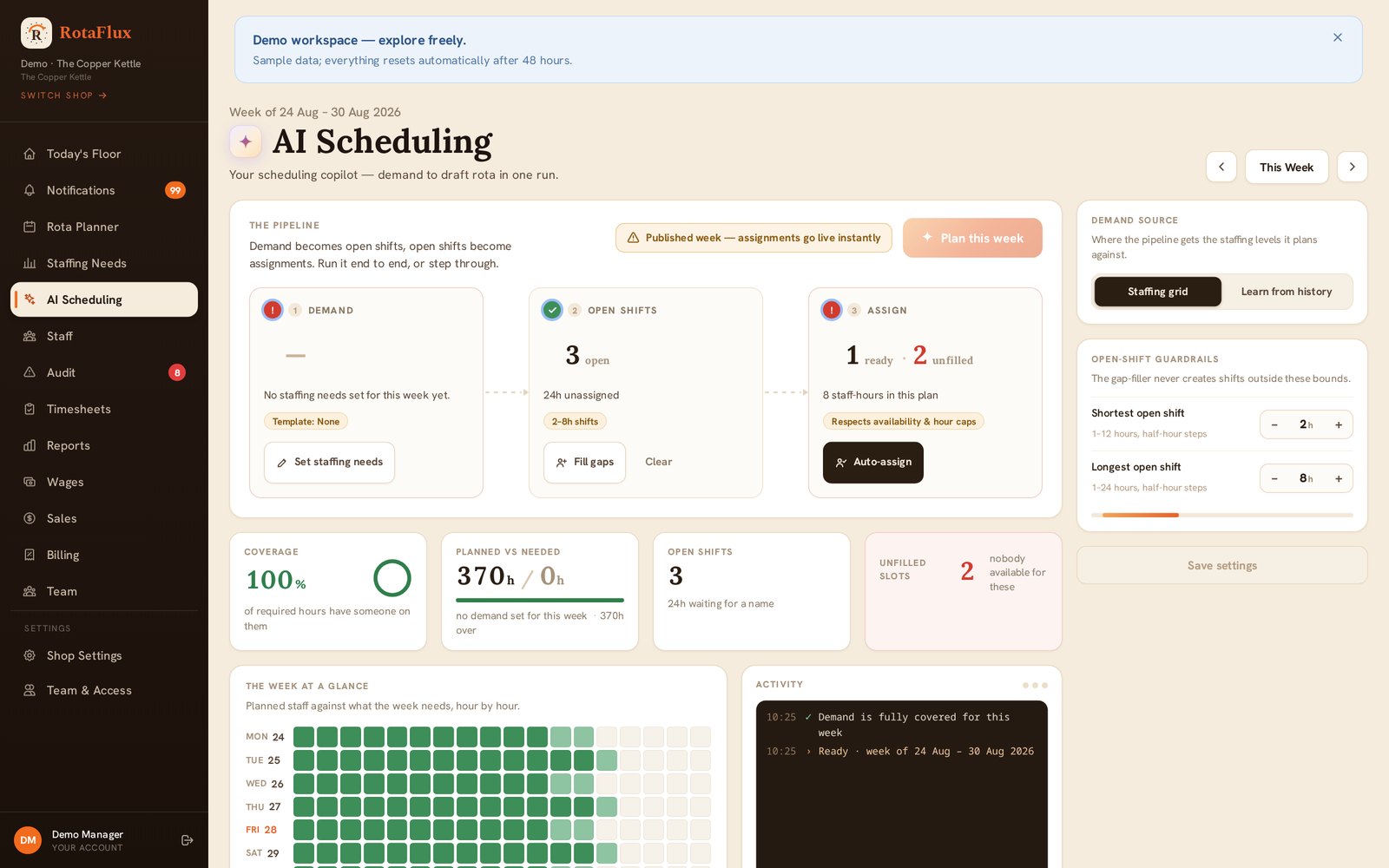
AI Scheduling
The scheduling copilot as an explicit three-stage pipeline - demand, open shifts, assignment. It can run end to end or be stepped through, respects availability and hour caps, and never generates a shift outside the guardrails the operator sets.
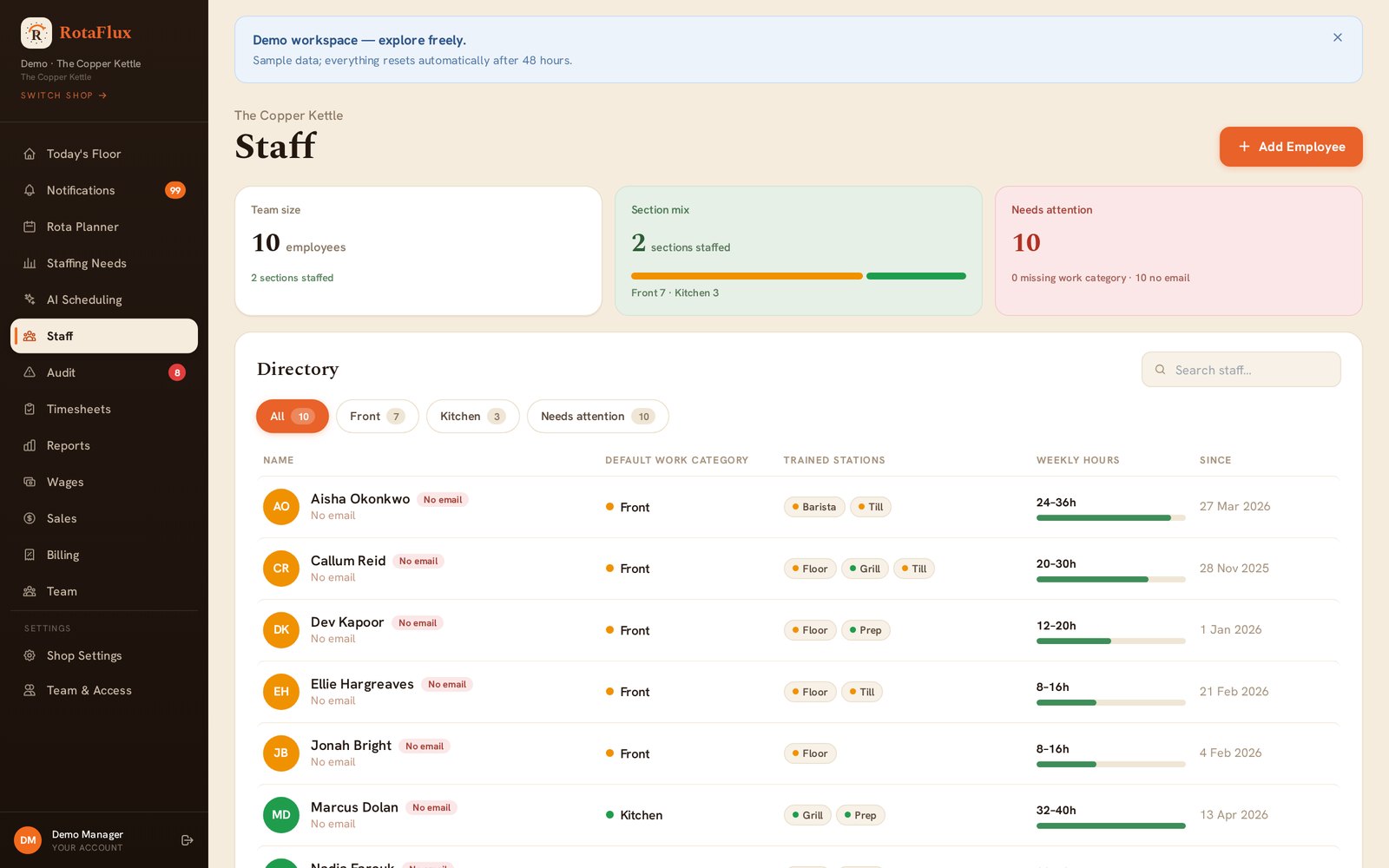
Staff & Availability
The people record behind every assignment: contracted hours, skills by section, availability windows and employment status - the constraint set the scheduling engine plans against.
Attendance Audit
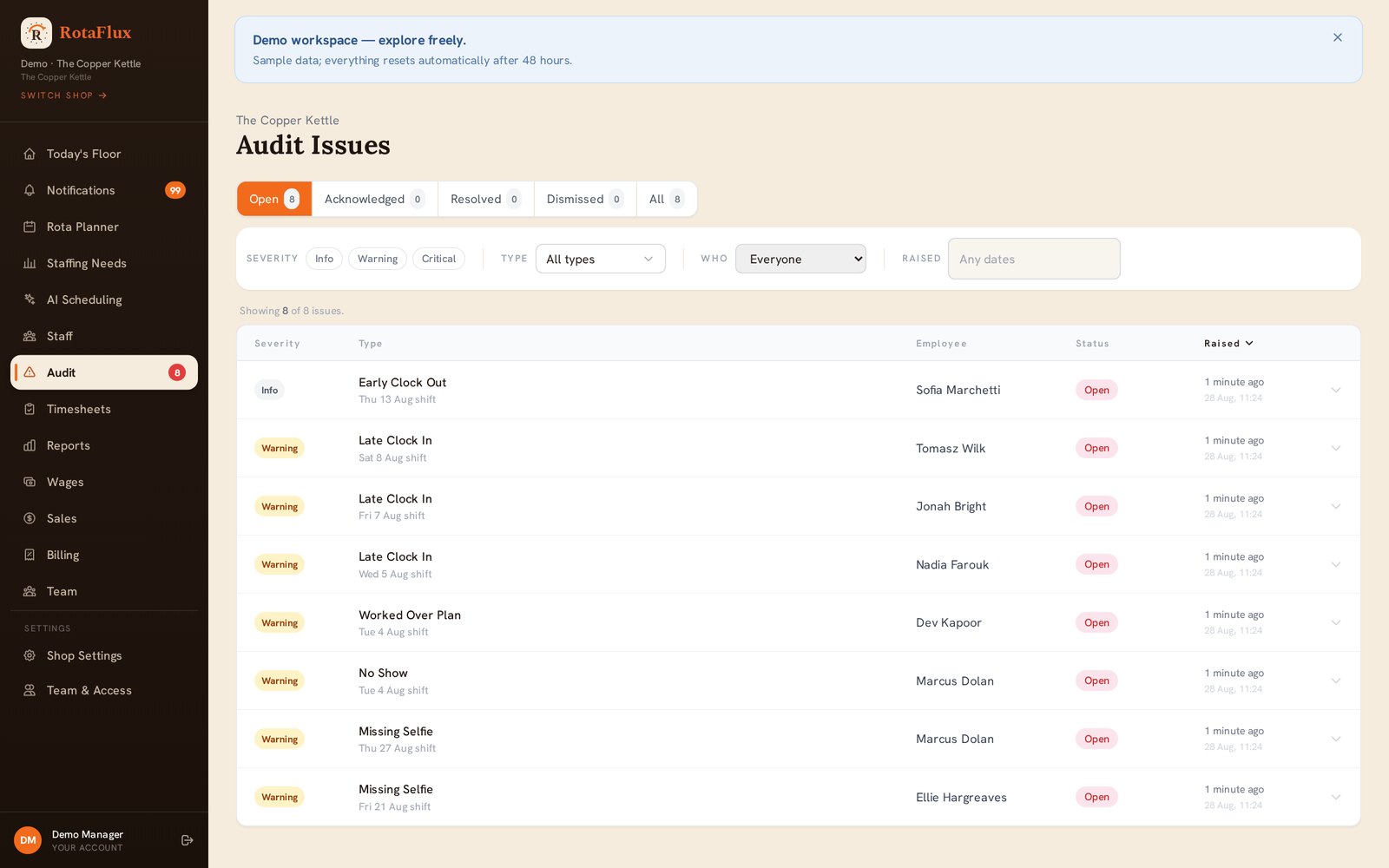
Every clock-in that deviates from the plan lands in a reviewable queue - early starts, late arrivals, missed clock-outs, no-shows. Nothing is silently corrected, so the payroll trail stays defensible.
Timesheets
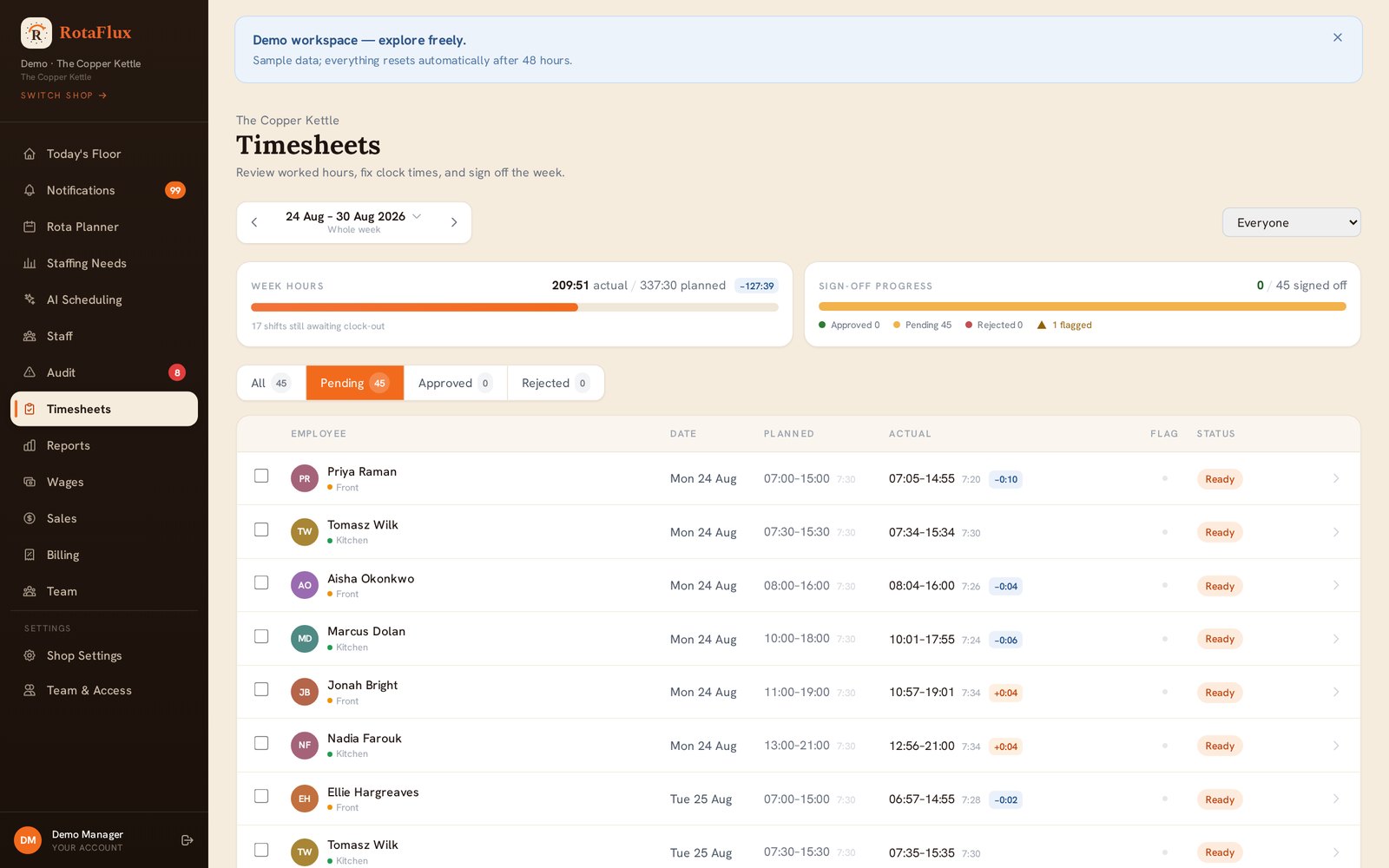
Attendance resolved into approvable, payroll-ready hours. Managers review exceptions rather than re-keying a week, and approval is a recorded action with an author and a timestamp.
Sales Analytics
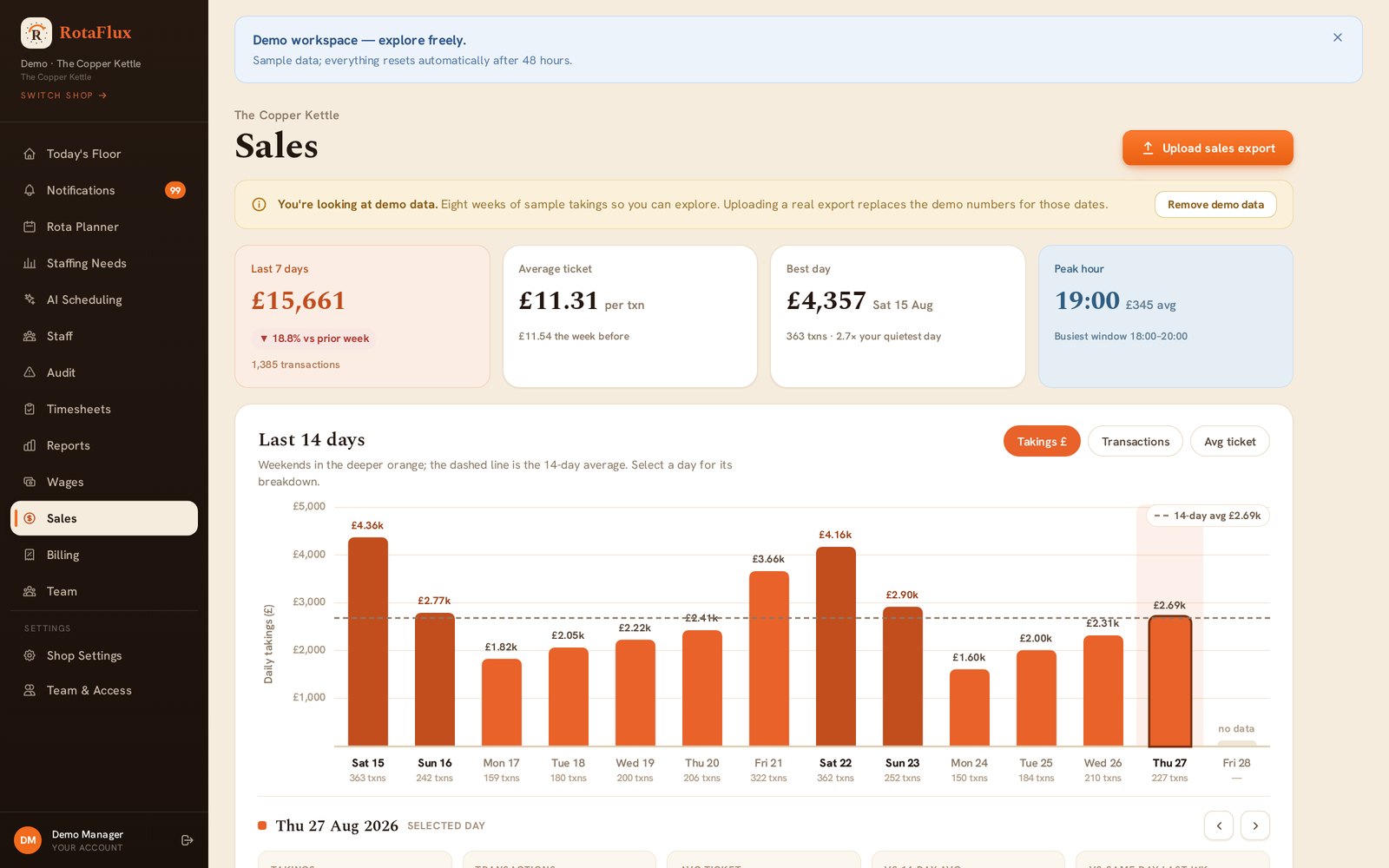
Till exports become an operational dataset: daily takings against a rolling average, average ticket, best day, peak hour and busiest window - the demand signal the rota is ultimately planned against.
Reports & Wages
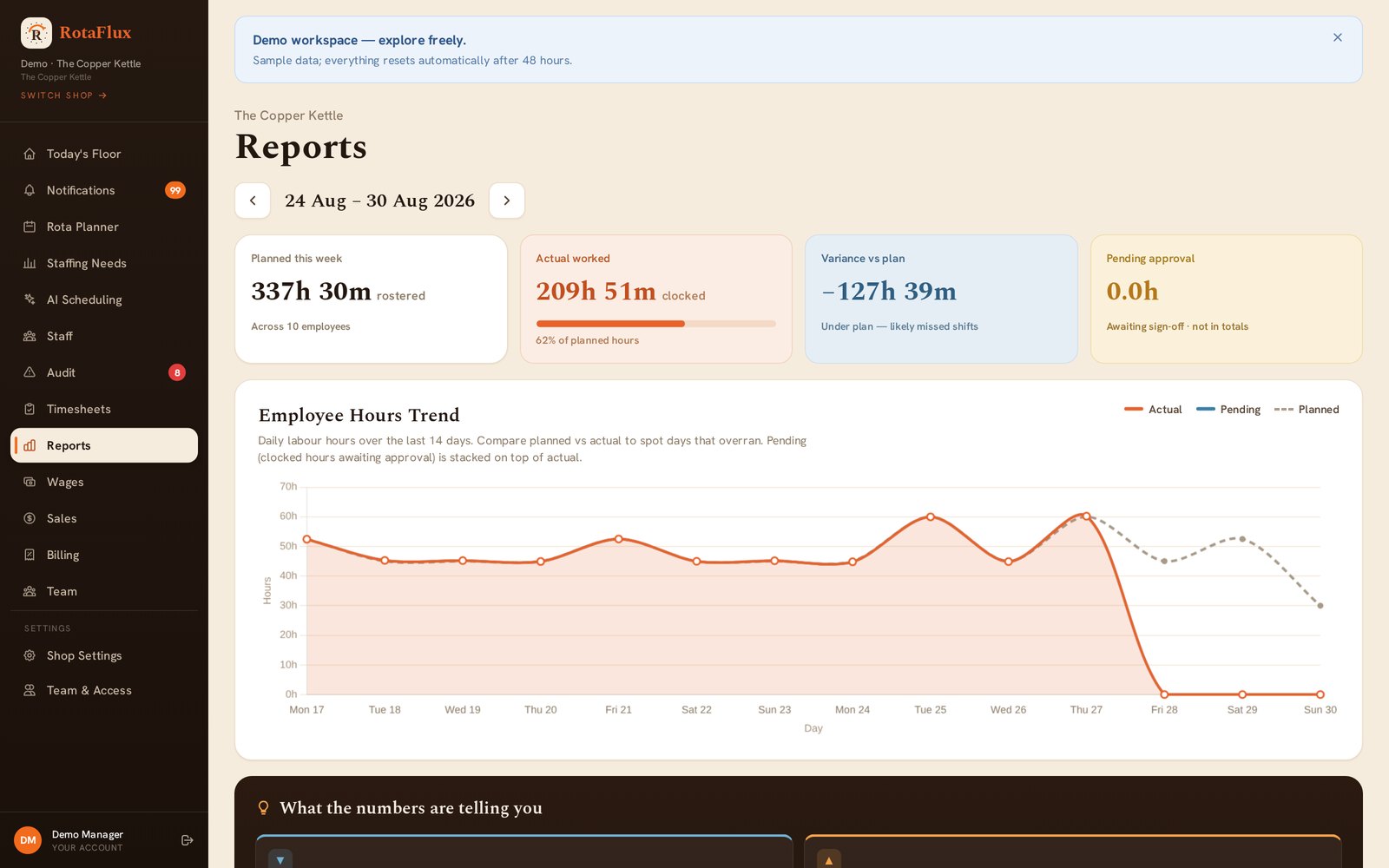
Cost reporting across the same timeline as revenue - hours, wage cost and labour against takings - so an owner can see what a quiet Tuesday actually costs before scheduling the next one.
1The scheduling copilot
The AI Scheduling module is deliberately built as a visible pipeline rather than a black box. Stage one establishes demand - either from a staffing grid the operator defines section by section and hour by hour, or learned from the shop's own trading history. Stage two converts that demand into open shifts, bounded by guardrails the operator controls: shortest shift, longest shift, half-hour granularity. Stage three assigns real people to those shifts while respecting availability windows, contracted-hour caps, skill requirements per section and statutory rest gaps. Each stage can be run individually or the whole pipeline executed in one pass, and every run writes to an activity log so a manager can see exactly what the copilot did and why a slot was left unfilled. That transparency was a product decision: schedulers will not adopt an engine they cannot audit.
2Live floor telemetry
Today's Floor is the screen the product is judged on, because it is the one open on the pass during service. It reconciles the published rota against live clock-in events in real time and renders four things a duty manager actually needs: who is physically on the floor right now and since when, who is running late or has not shown at all, how the coverage curve moves hour by hour across the trading day, and where the thinnest point of the day sits. A suggestions panel turns that data into plain-language nudges - a single person covering the 19:00 changeover, someone starting within the hour - so problems are handled before the queue forms rather than explained afterwards.
3Attendance, audit and payroll integrity
Clock-in data is only worth what it can be defended with. RotaFlux records every attendance event against its planned shift and routes every deviation - early start, late arrival, missing clock-out, no-show, out-of-geofence punch - into an audit queue rather than silently normalising it. A manager resolves each exception with a reason, and that resolution is attributed and timestamped. Approved attendance then flows into the timesheet module, where a week is reviewed rather than re-entered, and approved timesheets feed the wages view. The effect is that the number a business pays out can be traced, line by line, back to a specific event and a specific human decision.
4Sales as the demand signal
Labour planning without revenue context is guesswork, so RotaFlux ingests till exports and turns them into a first-class dataset: daily takings, transaction counts, average ticket, best and quietest day, peak hour and busiest trading window, all comparable against a rolling average and against the same day the previous week. Because sales and rota share a timeline, the reporting layer can put wage cost and takings on the same axis - which is what turns "we felt busy" into "Saturday 18:00-20:00 earns 2.7× the quietest day and is currently under-covered".
5Multi-tenancy, roles and billing
RotaFlux is multi-tenant from the schema up. An operator can run several shops under one account and switch between them without losing context, while data isolation is enforced at the query layer rather than the UI. Team and access settings allow granular roles - owner, manager, supervisor, staff - with permissions scoped per shop, so a supervisor at one site cannot read another site's wage data. Subscription billing, plan limits and invoice history are built into the product, and the whole platform is fronted by a self-serve demo workspace that provisions a fully populated sample café in one click and disposes of itself after forty-eight hours.
6Design and engineering approach
The interface uses a warm, high-legibility system - serif display type for hierarchy, generous density control, and colour used only where it carries meaning (green for on-shift, amber for exception, red for open risk). Everything is designed mobile-first because the primary device is a phone held in one hand behind a counter, and every dense table has a considered small-screen form rather than a horizontal scrollbar. On the engineering side, scheduling and reporting work runs asynchronously so the interface never blocks on a heavy pass, and the entire product is covered by a demo-data generator that can reproduce a realistic four-week trading state on demand - which is also what powers the public demo.
Interested in a similar project?
Let's discuss how we can bring your vision to life.
neurobridgetechnologies@gmail.com
Based in Lahore, PK
Serving clients globally
Registered ® with the Registrar of Firms
Services
© 2026 Neuro Bridge Technologies. All rights reserved.